|
The Terra
Firma Concept:
Jitter is Analogue
July 2011,
Part Two added Below
Preamble to the article: A
number of people have commented and expressed some cynicism about the
nature and content of the article below. "Nothing new" and "advertising"
and even that I didn't write the article, that it was written by Allen
Wright. Not true, indeed he did not read it until after it
was posted here. It has also been claimed that the article lack proper
substance and explanation, which I dispute entirely.
Now it can be stated that the type of jitter discussed below has been
measured/confirmed by Paul Miller in the UK, with access to equipment with
100 times the normal sensitivity and this magnification aimed at knowing where to
look. Normal jitter does not cause
digital sound (more like coluration we hear and adjust to in speakers).
But this is a specific ultra-low level type of jitter not yet fully
recognised for what it is and what it does.
This kind of jitter causes what we hear as
digital sound, where tonal colours are bleached out and also the cause of
longer term listener fatigue.
This type of jitter has been ignored as it looks like it is less than
1% of the total jitter spec and hence largely masked (but not by your
ears). As the article states below, it is where in
the audio spectrum where jitter shows up that is paramount. It is only a
matter of time before the facts will become better known to others, our
competitors. Until then we have the jump, below there are more than just
hints at what is happening. Please go ahead and read with care and an open
mind. Thank you. Joe Rasmussen.
The Terra
Firma Concept:
Jitter is Analogue
While we exist in a Digital
Age, the environment that surrounds us, the physical world, is all
analogue. When digital data (the content) has to be processed, it comes
into an analogue world. The digital content is now a stream and is at the
mercy of an analogue world. The content is maintained, but below the
content the analogue world will put its own footprint.
And it is far more
audible than we ever imagined!
Ultimate Digital
Playback deserves Ultimate Stability!
On this Page:
THIS IS ABOUT THE IMPORTANCE OF CLOCKING CD PLAYERS AND DIGITAL
PLAYBACK - AND A NEW STANDARD OF PERFORMANCE - HOW TO MAKE DIGITAL SOUND
MORE LIKE GOOD VINYL
The
following are edited excerpts from an article written for the Audiophile
Society of NSW, July 2008 Newsletter:
"Terra Firma" and
Why Jitter
Is Analogue?
I am excited and I have good reason to be. There is
also reason for you to be excited as well. There have been some truly
significants events that may well redefine digital playback once and for
all time.
Some of you may have read March 2008 issue of The
Absolute Sound a ground breaking review of the Esoteric G-0Rb "Atomic
Clock. If you can get a copy of that issue, it is on Page 124 and very
well worth the read. It may well be the most single significant article
written in that magazine re digital audio.
This review by Robert Harley is already causing a stir
in certain quarters and while the review subject is the Esoteric “Atomic
Clock” is USD $15,000 there will not be a great market unless a mass
produced low cost version is made and even then it will only be cheaper
but NOT cheap. Even so, most mainstream players have no way of getting
sync.
“The Esoteric G-0Rb Master Clock Generator
rendered a much bigger gain in musical realism that I would have thought
possible… It had a liquidity, ease, and naturalness that I’ve never
heard before from digital audio reproduction. The hardness in the
midrange, the glassy shattering sound on leading-edge transients, and
the dynamic constriction were all gone, replaced by a silky smooth yet
powerful rendering… more vivid… involving… sounding more like the real
thing and less like synthetic recreations.”
He goes on at length that this is beyond any previous
expectation he had of what he thought was the limits of CD playback.
But is this final great leap going to be beyond
us Average Joes?
How Long Will It Take To Save
$15.000?
But unconsciously Harley is pointing to another
solution. While the sonic improvement is beyond question (I know because I
and now others recognise they have heard the Holy Grail of digital
clocking) he states that this Rubidium clock is power supply insensitive:
"Most other digital audio employ a voltage
controlled crystal oscillator[VCXO]... Because
the VCXO’s output frequency is a function of the voltage across it, any
ripple or variations in the power supply will cause the frequency to
change - the very definition of jitter... A Rubidium clock is not only
more precise and stable than a VCXO; it is not subject to such
variability in its output frequency."
(BTW, not all oscillators are really VCXOs, but Harley
seems to use it as a generic description for powered oscillators rather
than cheap crystal oscillators.)
Ahah! So the Rubidium clock is insensitive to
power supply and oscillators are highlysensitive.
If your player has a decent clock, it will be a powered oscillator.
But does that mean that our oscillators should all be thrown into the
trash can? Far from doing that,realise the Achilles Heel may not the
oscillator itself but the
power supply that it is connected to. And this is
something we are
specialists in. So is there another way to get ‘Atomic’ quality clocking?
If we can stabilise the
VCXO's power supply, extreme
stability, then the performance of our more common garden oscillator
(relative to Atomic Clocks) will take on a level of performance that will
simply take your breath away.
How to Get Extreme Stability?
Harley talks about stability, he gets the point. This
is surely the antidote
to jitter. Our clock power supply needs to be as stable as the very ground
we walk on; hence may I introduce you to the concept of Terra Firma.
The earth is the biggest rock mass we can access and hence it has the
greatest physical stability available. In the physical world, anything
that moves will generally move in cycles. The equivalent electrical
concept isAC. The earth, relative to our position in the physical
world is DC. Now that is
stability and this is our ultimate aim.
Some who work in various labs are familiar with heavy duty anti-vibration
tables that are spiked to the ground - so tests can be performed that are
not influenced by vibrations.
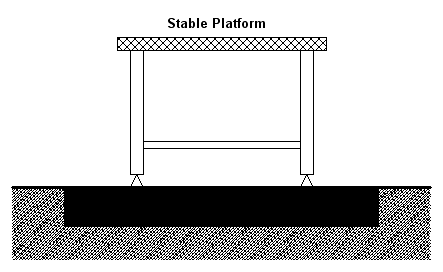
Is this perfect? No, but the aim is to be as stable as the very ground it
sits on, DC like and expulse AC like movement. In above case the table
sits on a steel enforced concrete slab set into compacted rock hard soil
soil (often clay). The actual platform I have seen is a synthetic and
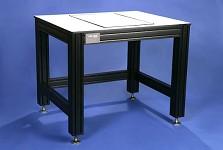
extraordinary dense granite. In some cases there will be an anti-tuning
device fitted under the platform or part of the frame. This is suitable
for high powered microscopes. A commercial version designed for
microscopes may look like this:
Can we make a power supply so rock like stable
that it has the stability of our mother planet Terra Firma?
No, we cannot achieve it perfectly, but what we can
produce is a power supply that hasextreme stability in
a way that has not been done before. Just as the Atomic Clock is one way
to achieve this extreme result, we now have a much more inexpensive
solution that may well be proven even superior.
We can now look at CD and digital playback in an entire
new light. I was among those back in 1983 that heard first generation
players and it was quite horrible. There have been generational
improvements along the way - not so much the technology persé but
also the implementation of it. I say this because the now obsolete Philips
TDA1541A came out in the second half of the 80's and to many still the
most brilliant DAC ever. So why did they not sound that good back then (in
fact they still sounded better than much of the pack). A modern
implementation of a 1541A DAC is capable of superb analogue like sounds
even today. Clock it
right, get the fundamentals right too and it is pure magic. Only now are
we getting a handle on what jitter really does. We hear it when it is
banished.
Back to Harley: In his sidebar article on the History
of Jitter he points out the disbelief by much of the Audio Engineering
Society that bits were not just bits. The notion of jitter was considered
lunacy - you had the credibility of necrophiles and paedophiles (I kid you
not) and if you believed in it you were plainly a dangerous person.
"Put an analog signal down a
wire, it degrades... not to mention subjecting the signal to every other
component in the signal path... audiophiles noticed musically different
variations between coaxial and Toslink connections, brands of digital
cables - how could the sound change? What mysterious "X" factor that
caused [proven] identical digital bitstreams to exhibit an analog-like
variability."
That last phrase "analog-like variability" is indeed
highly significant. Making physical changes to, not just cables, but other
things that deal with the digital datastream - without loosing data - had
an "analog-like variability" when converted to analogue and clearly
audible. Hence it seemed that digital changes made for analogue like
changes. Digital was not supposed to behave this way – bits were supposed
to be bits, no matter what.
You
see: Jitter is Analogue!!!
Surely that cannot be? We think of jitter as a digital
artefact, but quite plainly it is not (quantisation error is, but that is
another subject). But it is oh so easy to prove. Back in the early days of
CDs we noted that the laser pickup's output was a waveform, an analogue
waveform (sorry, but I insist on spelling analogue correctly). In fact,
you can display it on an analogue oscilloscope - there it is, right on a
screen, a waveform.
Harley has previously pointed out that if your
datastreams are identical, that is "zero for zero" and "one for one"
throughout the stream, the classic binary code, then you have 100% data
retrieval. If then these datastreams are converted and clearly sound
different, it isn't some error correction but something below the
level of that datastream. He then correctly made the conclusion, it can
only be jitter.
Jitter
is “Sub Data Error”
Digital is the content, but analogue is the carrier or
the form, the actual structure that propels the data. While digital exist
as content alone, on your disk or music server hard drive, there is no
jitter as such. But once it in motion it consists of a waveform, voltage,
current, noise floor and full spectral content, it is all analogue in
behaviour.
It is remarkable that we can now conclude that the
error inherent in digital is all analogue, the content (program) is
digital, the error content (jitter) is analogue.
While we exist in a Digital Age, the
environment that surrounds us, the physical world, is all analogue. When
digital data (the content) has to be processed, it comes into an
analogue world. The digital content is now a stream and is at the mercy
of an analogue world. The content is maintained, but below the content
the analogue world will put its own footprint. And it is far more
audible than we ever imagined.
In fact we are only really now, 25 years after the
emergence of CD playback, become aware just how much jitter matters, as
Harley concurs in his article.
For many years I have been witnessed by countless
number of persons, saying that Low Frequency Jitter is the worst and most
audible of all. I have stated ad
nauseum that power supply noise is
the source of this worst kind of jitter and the noise floor should remain
ultra-low down even to well
under Sub One Hertz. Unfortunately, linear cum analogue circuits have
by nature rising noise below 100 Hertz, just look at any published graph
of any opamp and amplifier or power supply, there is a rise in both
voltage and current noise, even the single humble transistor does this.
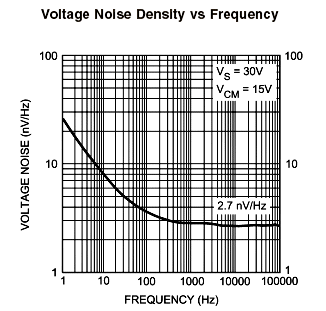
This is typical of all analogue circuits, in this case the highly
acclaimed low
noiseLM4562
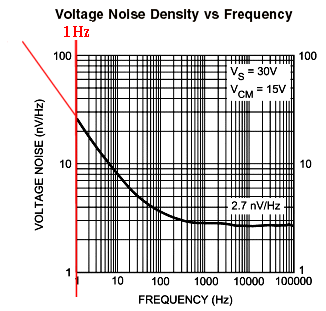
now used by DEQX, Hypex and others. In fact, the above is above average
(nominally 2.7nV/Hz) but rising well below 100Hz and still rising at and
below 1 Hertz.
Edit 22/1/2013: There is an effect known as "Allan
Variance" that may have a significant influence. This is a controversial
subject as sub 1 Hertz deviations are not accepted as negatively
infuincing at audio frequencies. Yet the Terra Firma Clock does indeed
confirm sub 1 Hertz effects as critical to high-end digital audio.
As for batteries, they too are entirely inadequate. We
have known that analogue noise is the enemy of all digital
circuits since about 2003. Now we are learning exactly to what extent.
Again, can we see the connection? We have a VCXO that
is usually powered by 3.3V - it needs power. The power we put into it has
a noise content that can be defined spectrally.
The added jitter that comes out of the oscillator
is directly proportional to the spectral content of the noise, analogue
noise, not the digital content.
Hence, if we have Low Frequency noise (the worst kind),
and the result is, the VCXO will add Low Frequency jitter. Higher
frequency noise will add jitter content commensurate with that frequency.
The analogue's spectral noise content is producing jitter of similar kind
and frequency. It is as plain as that, analogue noise in, analogue jitter
out. Jitter even has a frequency response! Again: Jitter is all analogue!
Harley is correct, the Esoteric Rubidium clock shows
just how far we have fallen short, but this will not be the case much
longer. The Atomic Clock’s superiority is as much due to the fact that the
power supply dilemma demonstrated here is taken out of the equation. Now
we come to the really good news. The Phoenix will rise from the ashes
(trash can?), the VCXO will still emerge as everyman’s winner.
Do You Need a Bottomless
Pocket?
No, and emphatically so. I believe these are exciting
time, while some say that CDs are in a decline, the fact remains that
digital playback is here to stay even if it will be music servers (hard
drive) based and not optical playback, and we may see the demise of the CD
player. But even Music Servers will need to be clocked once the content is
read into a live stream.
The best news of all is simply this. We do not
need to spend $15K and that affordable playback, that will scale new
heights that few have yet even to imagine, is here.
NEW!
Part Two (added
July 2011)
PLEASE TAKE A LOOK AT THE GRAPH BELOW
WE SHALL REFER TO THIS ONE AND ATHER ONE
LATER FOR COMPARISON
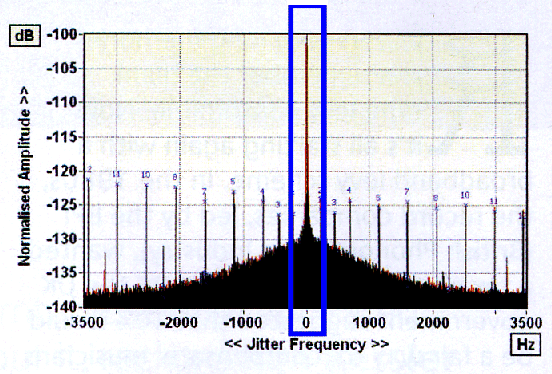
Please also note the Blue box
as we shall magnify it 100x later
Please note there are TWO measurements in the above graph, one is Black and
over-layed on another Red measurement.
Later we shall see the differences as we will look at and magnify 100x
what is in the Blue square.
Some may have wondered why Terra Firma Clocks don't come with jitter
specs? The reason is that Terra Firma takes an entirely different approach
to jitter and also sorting out which KIND of
jitter that is the most harnful as measured by the most powerful spectrum
analyser we have, the ear.
We shall call it... UNL Jitter
In the above graph which is DUAL measurement of two different but related
digital interfaces, one noted to sound quite superior to the other, but at
the magnification shown above seems to hardly measure any different.
Yet the SOUND different!
Let me start with in analogy, two pairs of loudspeakers. For our purposes
they are both of the same quality, have the same frequency response, both
the same LF extension, low distortion through-out etc. So these speakers
should sound very similar, but alas we are not surprised that they don't.
They will still have a different "voice" and as such they can still be
perceived as sounding different. Again, let us say state that they are
both speakers of extreme high quality, their differences now really
becomes a matter of taste and in selecting a preference, nothing more.
Now you may wonder what this has to do with jitter? It simply illustrates
that jitter specs can be similar and yet the players sound different. Just
like speakers, jitter can "voice" a player.
But the one thing we could never stomach in a speaker is DISTORTION, even
if the frequency response is flat etc. If something is OBVIOUS, then there
is a CAUSE.
Same goes with digital playback, we can become obsessed with jitter specs
when in fact they only "voice" the playback sound. But in the above DUAL
measurement graph, both very similar to the other, why
did one sound so much better that the other.Something OBVIOUS must
be happening. But this OBVIOUS thing is not apparent in the above
measurement, so where now?
Could it be the is
another jitter mechanism that is FAR WORSE?
Well, isn't jitter just jitter?
NO WAY! Indeed jitter can be MASKED by the actual jitter measurement
itself.
The idea behind Terra Firma, from the moment the name was thought up, was
that there are roughly two kinds
of jitter. One that "voices" and the other that makes digital playback
much less listenable than that good ol' analogue playback. And that form
of jitter is generally masked and very difficult to measure. And yet it is
OBVIOUS.
Terra Firma targets
jitter that is caused by "Low Rate Uncorrelated or Noise-Like Jitter" -
to quote Paul Miller.
So there you are, we even have a "name" for it, albeit a cumbersome one.
This kind of jitter is very hard
to measure. But it is also the kind of jitter that makes digital sound
DIGITAL. Peculiarly, the other forms of jitter are far more likely to make
sonic differences that are perceived as analogue differences. Hence we can
hear the differences in digital cables etc., as Harley points out, things
like digital cables takes on analogue behaviour.
But rarely are these difference DESTRUCTIVE in nature, more like "voicing"
in speakers and we pick our preferences.
But we are targeting
something beyond "voicing" - something OBVIOUS to the ear as WRONG,
something we have collectively coined... DIGITITUS !!!
UNL Jitter,
Uncorrelated Noise-Like Jitter.
Let us look at an actual example:
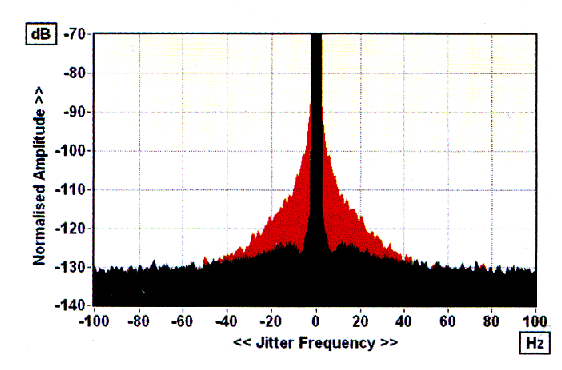
Please also note the Blue box
above magnified by a factor 100x
(Is this a measurement revealing "Allan Variance"?)
In the DUAL graph in the first graph, we can see that there was very
little difference between Red and Black,
but it was also stated that Black was
observed to sound quite a bit better than Red.
Now what was contained in the Blue box has been magnified something like
100x - and NOW we can see a significant different. UNL
Jitter is very obvious. This was a measurement made by some extreme
piece of measurement worth hundreds of thousand dollars (by Paul Miller).
I doubt any clock manufacturer have access to something capable of this,
we certainly do not.
But do not despair, the effect is quite audible and a product that tackles UNL
Jitter can be done simply
by knowing what you are targeting and the LISTEN to it.
A few comments re above magnified DUAL graph:
From the previous first graph above we can see that the sidebands are
clearly within normal audio bandwidth, we can also see their relative
amplitude.
Now closely examine what happen with the Red overlayed
under Black. We can see
Red clinging and rising with the fundamental and I can see some thing up
to near -70dB - and now compare that none of the sidebands are worse than
-120dB, and this is truly DISTURBING. Even
at 40dB difference in amplitude, were are talking about 100x the amplitude,
and possibly much worse than that at it is masked on potentially several
fronts and likely to be much worse than that. In regular jitter
measurements, UNL Jitterwon't
even show up, and is probably less than 1% of the overall jitter
measurement. Yet it is catastrophic in behaviour. If in doubt, look at the
AMPLITUDE of UNL Jitter.
In above example I see at least 50dB (300x), but I suspect even higher
levels of magnification will reveal much higher AMPLITUDE. The problem is
that the fundamental is doing its level best to mask it.
It is also clear that we are talking about ULTRA-ULTRA-LOW FREQUENCY
behaviour. How low, you may ask? Initially we targeted low hundreds of a
Hertz, then in the thousandths of a Hertz, finally millionths of a Hertz.
And it was very audible, even in blind tests.
Is this something that is not fully understood? Both Allen and I agreed
that was the case. I made the point how can something that takes so long
to eventuate yet still show up within the audio band, simply because the
time constant is so long, how can it show up in music that is a series of
short term events.
Maybe think something quantum going on? It is an intriguing thought.
What is clear is this to
measure UNL Jitter is
for real, because it can be seen by exceptional measurement systems, but
yet difficult to put a quantifiable number on it.
Joe Rasmussen
At the Cross Roads
www.customanalogue.com
(Above article is an edited version of article
published in the July 2008 issue of ASoN's Newsletter.)
|